Sourcing educational toys for global markets requires more than copying the best-selling product from another country. Buyers must understand children, parents, teachers, retailers, and local purchasing habits. The real question is: what trends are shaping the educational toy industry? Current demand is moving toward open-ended play, STEM learning, social-emotional development, inclusive design, and carefully balanced screen-free experiences. Products should invite children to build, test, imagine, and solve problems. Bright packaging alone is no longer enough.
Dr. Michael Yogman, a pediatrician and lead author of the American Academy of Pediatrics report The Power of Play, wrote, “Play is not just about having fun but about taking risks, experimenting, and testing boundaries.” This principle gives sourcing teams a practical filter. A robotics kit should allow several solutions, not one fixed result. A puzzle should challenge different age groups without creating unnecessary frustration. A pretend-play set should reflect varied families, abilities, and cultural settings. Small details matter, including readable instructions, durable hinges, washable surfaces, and parts that are easy to store.
Reliable sourcing also depends on evidence. Review product testing records, teacher feedback, return data, and repeat-order patterns before committing to large volumes. Check safety documentation and supplier quality systems carefully. Sustainability is influencing buyers, but recycled materials do not automatically create a better toy. Material strength, repairability, packaging size, and end-of-life options deserve equal attention. Trends can change quickly. Some forecasts will be wrong. A cautious buyer should test limited batches, compare regional responses, and revise assumptions before scaling globally.
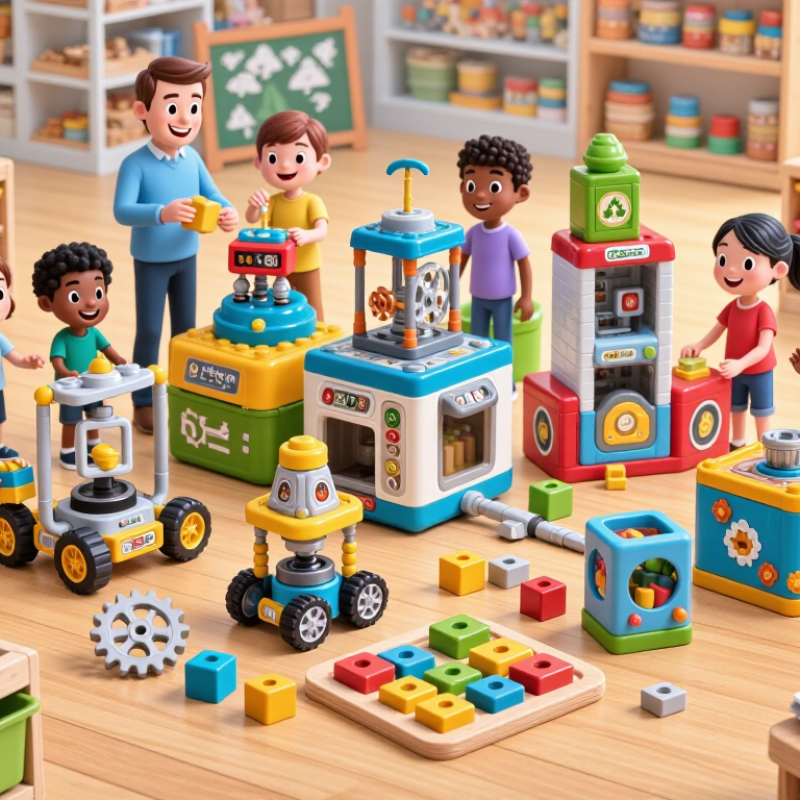
Educational toys should be grouped by learning purpose, not only by age. Core categories include sensory play, language development, STEM construction, social-emotional play, and fine-motor practice. Each category answers a different buying question. A preschool buyer may want washable pieces and clear skill goals. A school distributor may require classroom durability, replacement parts, and teacher guides. Parents often seek quiet play, safe materials, and visible progress at home. These needs overlap, but they are not identical.
When sourcing globally, map buyers by region, sales channel, and use setting. Urban retailers may favor compact packaging and multilingual instructions. Schools may prioritize bulk pricing, storage efficiency, and measurable learning outcomes. In some markets, open-ended building sets sell better than scripted activities. In others, culturally familiar stories improve engagement. I have found that age labels alone provide weak market research. Observe product reviews, classroom routines, and return reasons. Small details matter. A missing translation can stop a purchase.
Reliable sourcing requires material specifications, factory quality checks, and testing against applicable safety rules. Ask for sample units before approving a large order. Check sharp edges, loose components, odor, print clarity, and instruction accuracy. Keep records for batch numbers and corrective actions. I once treated attractive packaging as a demand signal. That assumption failed when buyers wanted refill parts instead. The lesson is uncomfortable: trend reports can mislead without local validation. Interview importers, teachers, and caregivers separately, then compare their priorities before defining the final toy range.
Sourcing educational toys for global markets begins with regional evidence, not a universal product list. Circana’s 2024 global toy review reported a 7% sales decline in 2023. Average prices increased 4% across its tracked markets. That pressure makes local demand testing essential. Euromonitor International’s 2024 Toys and Games analysis highlights digital play, developmental value, and affordability. These priorities compete. They are not identical.
In Europe, check EN 71, chemical limits, age grading, and the General Product Safety Regulation before sampling. In the United States, review ASTM F963 and CPSIA requirements, including testing records and tracking labels. China uses GB 6675, with additional attention to labeling and materials. Rules change. Verify them with an accredited laboratory or qualified compliance adviser. A supplier’s certificate alone is weak evidence.
Culture changes the brief. Japanese buyers may value compact, orderly, skill-focused play. Nordic families often reward open-ended, durable, outdoor use. Treat these as hypotheses, not stereotypes. Interview parents, teachers, and children in each target region. Test language, colors, story characters, noise levels, and adult guidance. UNICEF and the LEGO Foundation’s Learning through Play research links play with cognitive, social, emotional, and physical skills. However, it does not justify every “educational” claim. My common sourcing mistake is trusting attractive prototypes too early. A toy can pass safety checks and still feel culturally wrong.
| Target Region | Verified Market and Education Signals | Educational Toy Opportunities | Cultural and Language Preferences | Core Regulatory Checkpoints | Recommended Sourcing Action | Compliance Complexity |
|---|---|---|---|---|---|---|
| European Union | Strong emphasis on early childhood development, sustainability, accessibility, and digital safety. Products sold as toys must meet the applicable European toy-safety requirements. | STEM kits Open-ended construction Nature learning Inclusive play | Multilingual packaging is useful across member states. Neutral colors, repairable designs, recycled materials, and gender-inclusive play concepts generally support broad market acceptance. | Toy Safety Directive 2009/48/EC; relevant EN 71 safety standards; REACH chemical restrictions; CE marking; safety warnings and instructions in the official language or languages required by the destination country. | Prepare a technical file, risk assessment, declaration of conformity, test reports, traceability records, and language-specific packaging before shipment. | High |
| United States | Parents and schools commonly seek toys that support literacy, numeracy, coding, problem-solving, and social-emotional learning. Age grading and small-part controls are important purchasing considerations. | Coding concepts Math manipulatives Reading support Social-emotional learning | English is the primary packaging language, while Spanish-language instructions can improve accessibility in many communities. Clear age grading, concise instructions, and culturally diverse characters are commercially practical. | Consumer Product Safety Improvement Act requirements; applicable ASTM F963 toy safety provisions; third-party testing by an accepted laboratory; tracking labels; lead and phthalate limits; small-parts and choking-hazard requirements. | Confirm the exact product category and age grade, obtain required laboratory testing, maintain a children's product certificate, and review advertising claims for evidence. | High |
| Canada | Demand is supported by bilingual education environments, outdoor learning, STEM activities, and products designed for different developmental abilities. | Bilingual learning Outdoor science Fine-motor skills Accessible play | English and French labeling may be required depending on the product and market presentation. Winter, wildlife, community, and multicultural learning themes are suitable when represented accurately and respectfully. | Canada Consumer Product Safety Act; Toys Regulations, SOR/2011-17; lead and toxicological safety requirements; choking, flammability, labeling, and packaging obligations. | Build bilingual artwork into the packaging workflow and verify Canadian testing, labeling, import, and record-retention requirements separately from United States compliance. | Medium–High |
| United Kingdom | The market places continued value on phonics, early mathematics, practical discovery, sustainability, and screen-balanced play. | Phonics tools Early numeracy Eco-learning Tactile discovery | British English spelling and terminology should be reviewed separately from United States English. Designs that encourage independent play and provide clear parent guidance are well suited to the market. | Toys Regulations 2011; UKCA or applicable accepted conformity route; relevant British or designated toy-safety standards; chemical, labeling, warning, and traceability obligations. | Maintain a dedicated United Kingdom compliance file and check current marking rules before placing products on the market, especially when goods are also sold into the European Union. | High |
| Japan | Educational value, compact storage, careful workmanship, routine-based learning, and age-appropriate skill development are important product considerations. | Logic puzzles Fine-motor play Science experiments Compact sets | Japanese instructions, precise diagrams, restrained packaging, and compact footprints are advantageous. Product claims should be specific, modest, and easy for caregivers to verify. | Consumer Product Safety Association toy-safety certification practices may apply; Food Sanitation Law can be relevant to products intended for children under specified conditions; labeling and chemical-safety checks are required. | Use a Japan-specific instruction set, validate translated safety warnings, confirm the product's legal classification, and test materials for the intended age group. | High |
| South Korea | Digital learning, robotics, coding, language learning, and structured academic support are established themes in the children's education market. | Robotics Coding kits Language learning Engineering projects | Korean-language user interfaces and instructions are important. Products should provide measurable learning objectives, tidy storage, and clear progression from beginner to advanced activities. | Korean product-safety requirements for children's products; applicable safety certification or supplier declaration routes; chemical, electrical, age-labeling, and warning requirements. | Confirm whether the product falls under a safety-certification category before production and obtain Korean-language technical and consumer documentation. | High |
| Australia and New Zealand | Outdoor activity, inquiry-based learning, sustainability, resilience, and practical science are strong positioning themes. Products must suit varied climates and active play settings. | Outdoor science Nature exploration Building sets Practical life skills | Use clear international English and avoid cultural claims that inaccurately represent Aboriginal, Māori, or Pacific peoples. Durable, washable, and sun-aware product designs are useful for outdoor environments. | Applicable mandatory toy standards under Australian consumer law; AS/NZS ISO 8124 series may be relevant; choking, projectile, magnet, chemical, labeling, and electrical-safety checks should be reviewed by product type. | Conduct region-specific hazard analysis, verify mandatory standards before importation, and test durability for outdoor or high-use conditions. | Medium–High |
| Gulf Cooperation Council | Demand is concentrated in urban family markets, with interest in bilingual learning, technology, mathematics, science, and products suitable for indoor use in hot climates. | Arabic-English learning STEM Robotics Indoor activity sets | Arabic and English support can broaden reach. Review illustrations, clothing, gestures, music, religious references, and family roles for local cultural suitability. Avoid imagery that may conflict with local customs. | GCC conformity requirements for toys; applicable technical regulation and conformity-assessment procedures; chemical, mechanical, flammability, labeling, and Arabic-language warning requirements. | Select an importer familiar with local conformity procedures, prepare Arabic warnings and instructions, and check each destination country's customs and documentation rules. | High |
| India | Large-scale demand for foundational literacy, numeracy, low-cost STEM, problem-solving, and multilingual learning is supported by a wide range of income levels and education settings. | Foundational learning Affordable STEM Counting games Teacher-led kits | Products should accommodate English plus relevant Indian languages where appropriate. Durable materials, low replacement costs, local stories, and activities that work in classrooms without reliable internet can improve fit. | Toys Quality Control Order, 2020; Bureau of Indian Standards licensing and applicable Indian toy standards; labeling, importer details, age grading, and safety documentation. | Confirm the applicable Indian standard and licensing route before production, design for price-sensitive channels, and validate translations with local educators. | High |
| Southeast Asia | Fast-growing urban populations, multilingual households, mobile learning, and demand for affordable academic support create opportunities for modular and scalable educational products. | Language learning Coding basics Math games Modular classroom kits | Adapt language, currency examples, names, foods, clothing, and community settings by country. Humid-climate durability, easy cleaning, and low-power or non-digital options are practical advantages. | Requirements differ by country. Depending on destination, suppliers may need to review national toy standards, electrical rules, chemical restrictions, labeling, import permits, and local-language warnings. | Treat the region as a group of separate markets rather than one regulatory area; start with a modular design and create country-specific packaging inserts. | Medium–High |
| Latin America | Opportunities include early literacy, numeracy, bilingual education, science activities, and affordable products that can be used at home or in schools with limited equipment. | Reading readiness Math practice Bilingual play Hands-on science | Spanish and Portuguese localization should be handled separately. Use locally understandable examples, inclusive family contexts, durable packaging, and instructions that work with limited adult supervision. | Regulations vary by country and may include national toy-safety standards, conformity marks, chemical limits, age grading, Spanish or Portuguese warnings, and importer or registration information. | Prioritize one destination country at a time, verify its conformity route with a local compliance specialist, and use packaging artwork that can be localized without changing the core product. | Medium–High |
| Sub-Saharan Africa | Educational access, foundational skills, teacher support, affordability, and products that function without continuous electricity or internet connectivity are important sourcing considerations. | Foundational literacy Numeracy Teacher kits Offline learning | Local languages, community stories, realistic skin tones, and culturally relevant occupations can improve engagement. Products should tolerate dust, heat, transport handling, and frequent classroom use. | Requirements differ substantially by country and may include national standards, importer documentation, labeling, chemical safety, small-parts controls, and conformity or pre-shipment inspection procedures. | Work with local educators to validate content, use robust and repairable parts, provide pictorial instructions, and confirm destination-country import and safety rules before shipment. | Medium–High |
Data basis: Regulatory references are based on publicly established toy-safety frameworks and standards in the listed markets, including EU Toy Safety Directive 2009/48/EC, United States CPSIA and ASTM F963 requirements, Canada's Toys Regulations, the United Kingdom Toys Regulations 2011, India's Toys Quality Control Order 2020, and applicable national or regional conformity systems in the other markets. Requirements can change and must be verified for the exact product category, age grade, materials, electronics, packaging, and destination country before commercialization.
Educational toy demand is becoming more specialized, not simply larger. Grand View Research valued the global educational toys market at approximately USD 62 billion in 2023. It also projects strong growth through 2030. This trend increases sourcing pressure. Buyers need suppliers who understand learning goals, safety testing, and regional preferences.
My supplier comparison begins with evidence, not attractive catalogs. I request factory audit records, product test reports, material declarations, and recent shipment references. Suppliers should explain compliance with relevant standards, including EN 71, ASTM F963, or ISO 8124, depending on the destination market. I also compare minimum order quantities, tooling fees, production capacity, defect rates, packaging options, and communication speed. The International Trade Centre recommends using trade data when assessing export reliability. Import records can reveal whether a supplier has consistent international experience.
Price can mislead. My earlier sourcing spreadsheet ranked low unit cost too heavily. That decision ignored testing delays and replacement expenses. A better comparison calculates total landed cost, including freight, inspection, duties, and possible rework. The 2023 global toy industry data from Circana showed weaker consumer demand in several major markets. Suppliers with flexible batch sizes may therefore reduce inventory risk. I still need to question every document. A polished certificate is not proof of current production quality. Random pre-shipment inspections and small pilot orders provide stronger evidence. Reliability grows through repeated verification, not promises.
Identify and compare reliable international toy suppliers by prioritizing markets with a larger child population base. The chart shows the percentage of each country's population aged 0–14 in 2023, a useful demand indicator for educational toy sourcing and market-entry planning.
Source: World Bank, World Development Indicators, “Population ages 0–14 (% of total),” 2023. Values are rounded and should be combined with supplier audits, product-safety verification, certification checks, lead-time analysis, and total landed-cost comparisons.
Product quality should be checked through evidence, not attractive samples alone. Request material specifications, factory inspection records, and recent laboratory test reports. Examine seams, magnets, wheels, and small parts by hand. Paint should resist rubbing and peeling. Age grading must match the toy’s real risks, not only its packaging. A toy may pass one test and still feel fragile during daily classroom use. That gap deserves attention.
Safety evaluation should cover foreseeable misuse. Can a child pull the handle too hard? Can loose pieces fit into a small-parts testing cylinder? Check sharp edges, odor, battery access, and packaging hazards. Keep batch numbers and supplier records for traceability. Requirements differ across markets, so local compliance specialists should verify documentation before shipment. Paperwork alone is not enough.
Pricing needs a complete view. Include tooling, testing, packaging, freight, duties, inspection, and expected defect costs. A low unit price can become expensive after rework. Ask for clear quotations at several order quantities. Scalability should be tested with a controlled pilot batch. Measure delivery time, defect rates, packing consistency, and production capacity. Then review whether the supplier can repeat the same result at five times the volume. Some factories promise growth too easily. I would treat that promise as unproven until capacity records and a second production run support it.
Global educational toy demand is expanding, but growth differs sharply by region. Grand View Research estimated the market at USD 58.8 billion in 2023, with a projected 10.8% annual growth rate through 2030. Treat this forecast as direction, not certainty. Local income, school systems, and parent preferences can change orders quickly.
Build flexibility into every sourcing decision. Qualify two suppliers in separate production areas. Keep core components unchanged, but adapt language panels, activity cards, and packaging locally. Use three volume scenarios: pilot, seasonal, and growth. Negotiate capacity rather than chasing the lowest unit price. It protects cash flow when demand disappoints. It happens.
A flexible bill of materials also reduces disruption. Choose standard fasteners, recyclable paper sizes, and interchangeable learning modules. Request documented test results before approving samples. Relevant checks may include mechanical safety, material migration, and age grading under applicable standards such as EN 71 or ISO 8124. The European Commission’s Safety Gate 2023 report recorded 3,412 product alerts, with toys among the frequently notified categories. Compliance cannot be added at the shipment stage. It must shape supplier selection, prototype reviews, and factory inspections. Euromonitor International’s 2024 consumer research also highlights growing demand for purposeful, screen-light play, but this trend should be validated through small regional trials. A useful pilot may test 300 units, two price points, and three learning themes. Track returns, parent comments, and reorder speed before increasing production. Some assumptions will fail. That is valuable evidence.
Demand differs by income, school systems, culture, and family preferences. Test local interest before building a universal product list. Prices rose while sales weakened in several markets. That tension matters.
European products may need EN 71, chemical checks, age grading, and general product safety compliance. United States products may require ASTM F963, testing records, and tracking labels. China uses GB 6675, with careful material and labeling checks. Rules change. Verify current requirements with qualified specialists.
Some families may prefer compact, orderly, skill-focused activities. Others may value durable, open-ended, outdoor play. Treat these ideas as hypotheses, not facts. Interview parents, teachers, and children locally. Test colors, language, noise, characters, and adult instructions.
Request factory audits, product test reports, material declarations, and recent shipment references. Compare minimum orders, tooling costs, capacity, defect rates, packaging, and response speed. Import records can show export consistency. Catalogs look attractive. Evidence matters more.
Not necessarily. Calculate total landed cost, including freight, duties, inspections, testing, and rework. A cheap product can become expensive after delays or replacements. I once weighted unit cost too heavily. That was a poor assumption.
Qualify two suppliers in separate production areas. Use pilot, seasonal, and growth volume scenarios. Negotiate capacity instead of only chasing low prices. Flexible batches can protect cash flow when demand disappoints. It happens.
Keep core components consistent, but localize activity cards, language panels, and packaging. Use standard fasteners and recyclable paper sizes. Interchangeable learning modules can simplify repairs and regional updates. Perfect flexibility is unrealistic.
Test about 300 units across two price points and three learning themes. Track returns, parent comments, safety findings, and reorder speed. Review the evidence before increasing production. Some assumptions will fail. That is useful.
Sourcing educational toys for global markets begins with clearly defining product categories, such as STEM kits, language-learning tools, creative activity sets, sensory toys, and early-development products. Understanding what trends are shaping the educational toy industry helps buyers identify growing demand for hands-on learning, digital integration, sustainability, inclusivity, and age-appropriate design. However, global success also depends on recognizing regional learning preferences, cultural expectations, purchasing habits, labeling requirements, and product safety regulations.
A reliable sourcing process should compare international suppliers according to manufacturing experience, communication, customization capabilities, quality systems, and delivery performance. Buyers should evaluate materials, safety testing, durability, educational value, pricing, minimum order quantities, production capacity, and scalability before making decisions. A flexible strategy can combine multiple suppliers, phased product launches, regular quality inspections, and demand-based inventory planning. By balancing innovation, compliance, affordability, and cultural relevance, businesses can build a resilient educational toy portfolio that adapts to changing market needs while delivering meaningful value to children, parents, and educators.

Briy Toys