Educational toys are more than colorful objects placed on a playroom shelf. They give children practical ways to explore language, movement, memory, problem-solving, and social skills. But what are educational toys, exactly? They are play materials designed to encourage learning through active, age-appropriate discovery. A wooden puzzle, for example, can strengthen spatial reasoning as a child rotates each piece. Building blocks can introduce balance, planning, and early mathematical thinking. Even a simple matching game may support attention and vocabulary when an adult asks thoughtful questions.
The value of these toys depends on how children use them, not only on their labels. Child-development research suggests that hands-on play can support cognitive, emotional, and physical growth. Experienced parents and educators often notice small changes: a toddler persists longer, describes colors more clearly, or invites another child into a game. These moments matter. Still, an educational toy cannot replace warm interaction, outdoor movement, stories, or unstructured imagination. Some expensive products promise remarkable results, yet their benefits may be limited when play becomes passive or overly controlled. This deserves reflection. A cardboard box may inspire more creativity than a complicated electronic toy. The best choice usually matches a child’s age, interests, abilities, and need for challenge. Safe materials, clear instructions, and adult supervision also support responsible use. Learning should feel meaningful. Play should remain joyful.
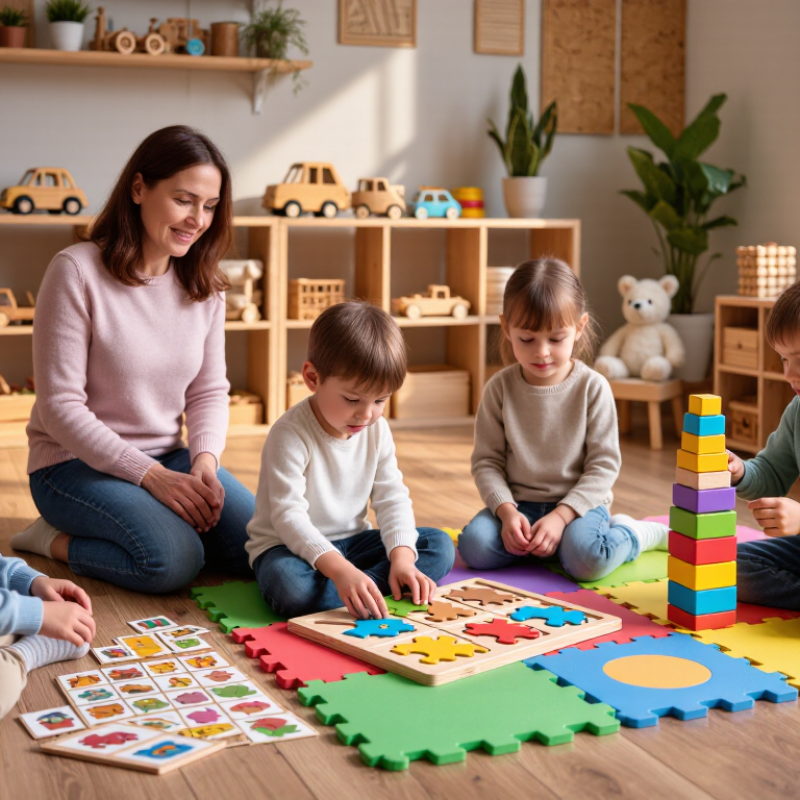
Educational toys are tools that turn play into purposeful learning. They may include puzzles, building pieces, counting games, matching cards, or pretend-play materials. Their value depends on how children use them, not on colorful packaging. A simple wooden puzzle can develop hand control, visual reasoning, and persistence. A pretend shop can encourage language, counting, and social negotiation.
The UNICEF and LEGO Foundation Learning through Play report identifies joy, active engagement, interaction, and meaningful learning as key features of effective play. Educational toys support these features when adults ask open questions instead of giving quick answers. “Why might this piece fit here?” invites reasoning. The World Health Organization’s 2019 guidelines recommend at least 180 minutes of physical activity daily for children aged three to four. Movement-based toys can support this target through balancing, throwing, and building activities.
However, toys do not automatically create learning. A child may ignore an expensive science kit and spend twenty minutes sorting bottle caps. That choice still deserves attention. The National Association for the Education of Young Children stresses developmentally appropriate, play-based learning. Adults should observe the child’s interests, adjust difficulty, and allow mistakes. Too much instruction can reduce curiosity. I have seen learning improve when adults pause longer, though this approach requires patience and is not always easy. A toy should open a conversation, not replace one.
Educational toys matter most when they make thinking visible. A child testing a wooden bridge learns through repeated failure: two blocks collapse, then a wider base holds. This small experiment practices prediction, planning, spatial reasoning, and flexible problem-solving. The American Academy of Pediatrics’ 2018 clinical report identifies play as a context for executive function, language, and self-regulation. Those skills support classroom learning more directly than memorizing toy labels. The toy does not teach alone. In practical classroom observations, children often abandon puzzles when the challenge feels arbitrary. A nearby adult can ask, “What could change?” instead of supplying the answer. That question encourages children to explain strategies, notice patterns, and revise decisions.
UNICEF’s 2018 Learning through Play report describes effective play as active, engaging, meaningful, iterative, and socially interactive. These features matter because problem-solving rarely follows one clean path. A sorting game might begin with color, then shift to shape or size. Children compare rules, defend choices, and discover that one object can fit several categories. The OECD’s 2023 Starting Strong report also emphasizes intentional, play-based learning and responsive adult interaction. WHO guidelines recommend at least 180 minutes of daily physical activity for children aged three to four, including 60 minutes of moderate-to-vigorous movement. Movement can sharpen attention, but evidence should not be oversold. A costly toy may produce less thinking than cardboard, buttons, and a clear question. I once assumed more features meant more learning; that assumption needs correction.
Educational toys matter because they turn ordinary play into repeated language practice. A child holding a toy phone may say, “Hello,” ask a question, or copy a familiar phrase. A pretend grocery set encourages naming foods, counting items, and negotiating roles. Language grows through exchange.
The American Academy of Pediatrics’ 2018 clinical report describes play as essential for healthy development and emphasizes responsive adult interaction. Toys work best when adults follow the child’s interest, add precise words, and pause for responses. Picture cards can introduce “rough,” “smooth,” or “empty.” Animal figures can support short stories with clear beginnings and endings. These small conversations build vocabulary, listening, turn-taking, and confidence.
The 2016 Lancet Series estimated that 43% of children under five in low- and middle-income countries faced risks to healthy development from poverty and poor nutrition. UNICEF’s 2019 A World Ready to Learn report also estimated that 175 million preschool-age children lacked access to pre-primary education. Play-based materials cannot replace qualified teaching or supportive care, but they can create language-rich moments at home. A toy alone does little. The adult’s attention changes its value.
In practice, too many features may distract a child from speaking. Simple toys often invite more imagination. That point deserves reflection. Not every play activity produces measurable progress, and children develop at different speeds. Caregivers should observe, listen, and adjust rather than force conversation.
How Play-Based Toys Develop Language and Communication
Play-based toys encourage children to name objects, follow directions, take turns, ask questions, and build stories. The chart shows the approximate age points at which the CDC lists increasingly complex communication milestones. Educational toys can provide repeated, engaging opportunities to practice these skills through meaningful play.
Source: CDC developmental milestones for children at 2, 3, 4, and 5 years.
Educational toys matter because play gives children a safe way to practice real social, emotional, and motor skills. In a small-group activity, children may pass wooden pieces, negotiate turns, and explain their choices. These moments build language and cooperation. A child who loses a game can name disappointment, pause, and try again. That tiny pause matters.
Open-ended puzzles, sorting trays, and pretend-play materials support fine-motor control. Picking up a small button-shaped piece strengthens the pincer grasp used for drawing and dressing. Larger building pieces encourage reaching, balancing, and coordinated movement. Adults should watch the child’s effort, not rush to fix every mistake. I have seen children stay with a difficult task longer when praise focuses on patience rather than speed. Still, one toy cannot create every skill. That expectation needs reconsideration.
Educational toys also shape emotional security. A predictable matching game can help a hesitant child join a group without immediate pressure. Cooperative challenges invite eye contact, listening, and shared problem-solving. Children may disagree, and that is useful practice when an adult models calm words instead of controlling the outcome. Choose materials that match the child’s age, interests, and current abilities. Rotate them occasionally. Too many choices can scatter attention, while overly easy tasks can reduce curiosity. Watch, adjust, and accept that the best learning moment may look messy.
| Developmental Area | Suitable Toy Types | How Play Supports Development | Skills Practiced | Observable Play Behaviors |
|---|---|---|---|---|
| Social Skills | Pretend-play sets, puppets, cooperative board games | Shared play gives children opportunities to communicate, negotiate roles, follow rules, and solve disagreements. | Turn-taking, cooperation, communication, perspective-taking | Waits for a turn, asks questions, shares materials, and adapts to another child’s ideas |
| Emotional Development | Dolls, emotion cards, storytelling materials, role-play figures | Symbolic play allows children to express feelings, rehearse everyday situations, and explore different viewpoints in a safe setting. | Emotion recognition, self-expression, empathy, self-regulation | Names feelings, comforts a toy character, creates solutions, or repeats a calming strategy |
| Fine Motor Skills | Puzzles, threading beads, construction pieces, play dough, drawing tools | Manipulating small or resistance-based materials strengthens hand control and hand-eye coordination. | Grasping, pinching, bilateral coordination, visual-motor integration | Places pieces accurately, uses both hands together, cuts or draws with increasing control |
| Gross Motor Skills | Soft balls, balance equipment, movement games, ride-on toys | Active play encourages children to coordinate large-muscle movements and adjust balance, force, and direction. | Balance, locomotor movement, coordination, spatial awareness | Runs, jumps, throws, catches, climbs, or changes direction with improving control |
| Cognitive Skills | Sorting games, building blocks, matching games, age-appropriate puzzles | Open-ended challenges encourage children to predict, test ideas, identify patterns, and revise strategies. | Problem-solving, memory, categorization, planning, flexible thinking | Groups objects by features, remembers rules, tries alternative approaches, and explains a solution |
| Language and Literacy | Picture books, story cards, puppets, alphabet and vocabulary games | Conversation and storytelling expose children to new vocabulary, sequencing, listening, and early print concepts. | Vocabulary, narrative structure, listening, phonological awareness | Retells events, describes objects, predicts what happens next, or recognizes familiar symbols |
| Creativity and Executive Function | Art materials, open-ended building pieces, music instruments, design challenges | Open-ended play lets children choose goals, sustain attention, manage materials, and create original solutions. | Initiative, attention, working memory, planning, impulse control | Follows a plan, stays engaged, changes a design, and completes multi-step activities |
| Independence and Confidence | Self-correcting puzzles, dressing frames, practical-life play materials | Manageable challenges provide practice with persistence, decision-making, and learning from mistakes. | Self-help skills, persistence, self-monitoring, confidence | Attempts a task independently, seeks help appropriately, and tries again after an error |
Choosing an educational toy begins with the child, not the colorful packaging. Check the recommended age range carefully. It reflects small parts, skill levels, and expected supervision. A puzzle for older children may frustrate a toddler. A simple stacking cup can build coordination through repeated play. Watch how the child handles it. Their actions reveal more than the box promises.
Safety requires close attention to details. Avoid loose magnets, accessible button batteries, sharp edges, and detachable pieces for young children. Check that paint and materials meet recognized local safety standards. Read cleaning instructions, especially for toys used during meals or teething. Examine seams, cords, and hinges regularly. Damage can appear after weeks of ordinary play. Keep instructions and check public recall notices when possible.
Educational value also depends on developmental fit. Choose toys that invite movement, language, problem-solving, or pretend play. Open-ended toys often support more creativity than products with one correct action. A caregiver might sit nearby and ask, “What could we build?” Supervision should match the child’s age and the toy’s risks. No checklist is perfect. I sometimes overestimate a toy’s learning value because it looks sophisticated. A quieter toy may create richer conversation and longer concentration. Rotate a few safe choices instead of filling the room.
Children test ideas through play. A wooden bridge may collapse twice before a wider base works. This builds planning, prediction, and flexible thinking.
Not usually. A nearby adult can ask, “What could change?” instead of giving the answer. That pause encourages explanation and revision.
Pretend phones, food sets, and animal figures create reasons to speak. Children name objects, ask questions, negotiate roles, and tell short stories. Simple works well.
Follow the child’s interest, add precise words, and wait for a response. Describe textures such as “rough” or “smooth.” Avoid controlling every move.
Check the recommended age range and observe the child’s actions. Older puzzles may frustrate toddlers. Stacking cups can offer safer, repeated coordination practice.
Avoid loose magnets, accessible button batteries, sharp edges, and detachable parts for young children. Inspect cords, seams, and hinges regularly. Damage can appear later.
Not necessarily. Cardboard, buttons, and a clear question may create deeper thinking than a complex toy. I once assumed more features meant more learning; that needs correction.
Choose open-ended materials for building, movement, pretend play, or sorting. A child might sort objects by color, then change to shape or size. One rule is rarely enough.
A few safe choices may support longer concentration. Rotate them instead of filling the room. More toys can mean more distraction.
No. They can create language-rich moments at home, but they cannot replace qualified teaching or attentive care. The adult’s attention changes the toy’s value.
Educational toys are designed to make learning active, enjoyable, and meaningful through play. When asking “what are educational toys,” the answer includes games, puzzles, building materials, books, and creative activities that help children explore ideas while developing important abilities. These toys can strengthen memory, attention, early mathematics, reasoning, and problem-solving by encouraging children to think, experiment, and find solutions. Play-based activities also support language and communication as children learn new words, explain their ideas, follow instructions, and participate in conversations.
Educational toys contribute to whole-child development. Cooperative games encourage sharing, patience, empathy, and emotional understanding, while creative play helps children express feelings and build confidence. Activities involving movement, construction, drawing, or manipulation can improve fine and gross motor skills. To be effective, toys should match a child’s age, interests, abilities, and stage of development. Caregivers should choose durable materials, avoid unsafe small parts for young children, check safety information, and select toys that offer appropriate challenges without causing frustration.

Briy Toys