In 2026, educational toys are becoming practical tools for children who learn beyond scheduled lessons. Their value is not limited to bright colors or electronic features. A well-designed construction set can place gears, cards, and problem-solving prompts directly into a child’s hands. The child chooses a challenge, tests an idea, notices failure, and tries again. This is the central question behind how educational toys support independent learning.
Industry data reflects growing interest in purposeful play. Circana’s 2024 global toy industry reporting identified renewed toy-market growth, with learning-focused categories benefiting from parents’ demand for meaningful home activities. The Toy Association has also highlighted STEM, creativity, and social-emotional development as important toy trends. These signals show commercial momentum, but sales figures cannot prove educational effectiveness. That distinction matters.
Research provides a stronger foundation. UNICEF and the LEGO Foundation’s Learning through Play report explains that play can build problem-solving, communication, and self-regulation skills. The OECD’s learning research similarly emphasizes learner agency, motivation, and practical application. Educational toys can support these outcomes when children control the pace and adults avoid solving every problem. A parent might ask, “What could you try next?” instead of giving the answer.
Small choices matter.
Independent learning is not automatic. Some toys overstimulate children, hide the learning goal, or depend heavily on adult instruction. Evidence also varies by age, design, and home environment. Therefore, this article examines useful features, measurable benefits, and common limitations. It also considers a necessary question: Are we buying more toys, or creating better opportunities for children to think, explore, and learn independently?
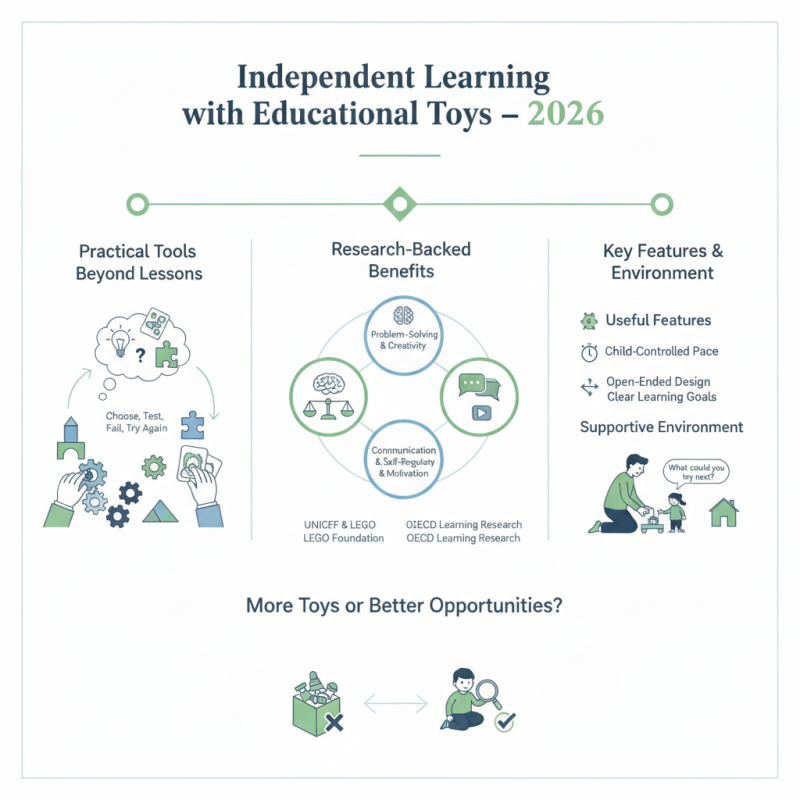
In 2026, independent learning means choosing a question, testing an idea, and adjusting after failure. It is not simply working alone. Children still need thoughtful guidance, emotional support, and reliable information.
Educational toys can create small, useful learning spaces. A child might build a bridge from wooden pieces, notice it collapses, and change the structure. Another child may use a science kit to compare melting times with ice cubes. These activities encourage planning, observation, and problem-solving. The toy should offer choices, not only one correct result. Open-ended materials often support stronger decision-making.
Digital toys can adapt tasks to a child’s progress, but adaptation is not the same as understanding. Adults should check whether feedback is accurate, age-appropriate, and clear. Privacy also deserves attention. A learning tool should not collect unnecessary personal information. In practice, independent learning can become messy. Children may abandon a project, copy an answer, or ask for help too quickly. That is not always failure. It can reveal where instructions, patience, or confidence need improvement. Teachers and caregivers can ask, “What will you try next?” instead of solving the problem immediately. This keeps ownership with the learner while preserving a safe path forward.
Educational toys can make learning self-directed when children control the question, pace, and next attempt. A child fitting gears, sorting tiles, or testing a balance sees immediate consequences. That feedback reduces dependence on adult correction. The 2024 OECD PISA Creative Thinking assessment covered about 64 education systems. Its OECD average was 33 points on a 60-point scale. The result suggests creative thinking needs practice, not occasional inspiration. Carefully designed toys provide small, repeatable practice.
Self-direction grows through choices with visible limits. A construction set may offer several solutions, while a logic puzzle allows quiet failure. Adults should ask, “What could you try now?” rather than demonstrate every move. Short instructions matter. The World Economic Forum’s Future of Jobs Report 2025 identifies analytical thinking as a leading core skill. It also reports that employers expect major workplace skill changes by 2030. Toys cannot predict that future. They can rehearse habits: comparing evidence, changing a plan, and explaining a decision.
Reliable design still requires caution. A toy with flashing rewards may capture attention without building judgment. A toy with no challenge becomes decoration. In practice, children often abandon tasks when the first attempt fails, and adults sometimes rescue them too quickly. That is an uncomfortable weakness. Observation helps: record the child’s choices, time, questions, and revisions. UNICEF’s Learning through Play guidance emphasizes active, engaging, meaningful, socially interactive, and iterative experiences. Those qualities are useful, but not automatic. A child may need fewer pieces, a clearer goal, or permission to invent a different rule. Independent learning is visible in the process, not merely in a correct final model.
Evidence-informed dimensions for evaluating how open-ended and educational play materials develop self-directed learning.
| Self-Directed Learning Skill | Educational Toy or Activity Context | How the Skill Develops | Observable Learner Behavior | Practical Measurement | Suggested Learning Benchmark | Evidence Basis |
|---|---|---|---|---|---|---|
| Choice and Goal Setting | Open-ended construction sets, art materials, science kits, and pretend-play resources. | Children select a purpose, define a desired result, and decide which materials or steps may help them reach it. | The learner explains what they want to make or discover before beginning and chooses materials without immediate adult direction. | Record whether the learner states a goal, selects materials, and starts within five minutes. | At least 2 independent choices during a 20-minute activity. | Supported by early-learning guidance from NAEYC and the OECD Learning Compass 2030. |
| Planning and Sequencing | Puzzles, coding cards, model-building tasks, sorting games, and multi-step experiments. | Multi-step play requires the learner to order actions, anticipate outcomes, and revise the sequence when necessary. | The learner describes or demonstrates a sequence such as “first,” “next,” and “then,” rather than trying actions randomly. | Count the number of steps completed in the intended order without an adult supplying the sequence. | Complete a 3–5 step task with no more than one prompt. | Consistent with executive-function research summarized by Harvard Center on the Developing Child. |
| Problem Solving | Balancing challenges, mazes, logic puzzles, building tasks, and materials with multiple possible solutions. | Children test ideas, identify obstacles, compare results, and select a revised strategy instead of waiting for the correct answer. | The learner tries a second method after an unsuccessful attempt and can describe what changed. | Track the number of distinct strategies attempted and whether the learner explains the cause of failure. | Try at least 2 strategies before requesting direct help. | Aligned with inquiry-based learning and problem-solving competencies in OECD education frameworks. |
| Persistence and Self-Regulation | Age-appropriate challenges with adjustable difficulty, timed construction tasks, and games requiring turn-taking. | Manageable challenge creates opportunities to tolerate frustration, pause, regulate emotions, and return to the task. | The learner remains engaged after an error, uses a break or calming strategy, and resumes without abandoning the activity immediately. | Measure active engagement time, recovery after an error, and the number of adult interventions. | Return to the task within 2 minutes after a setback. | Supported by research on executive function and self-regulation from Harvard Center on the Developing Child. |
| Metacognition and Reflection | Strategy games, science observation tools, journals, matching activities, and build-test-improve tasks. | Children compare their intention with the result, identify effective strategies, and decide what to change next time. | The learner answers questions such as “What worked?”, “What was difficult?”, and “What will you try next?” | Use a three-question reflection checklist after the activity and record independent responses. | Identify 1 successful strategy and 1 possible improvement. | Consistent with metacognitive learning principles described by EEF guidance. |
| Information Seeking | Magnifying glasses, measuring tools, classification materials, reference cards, and simple research prompts. | Children learn to notice uncertainty, ask focused questions, gather information, and use evidence to make decisions. | The learner asks a relevant question, observes or measures, and uses the result to modify an action. | Count relevant questions, observations, measurements, or reference checks completed independently. | Generate 1 relevant question and use 1 source of evidence. | Reflects inquiry and evidence-use practices in early science education guidance from NAEYC and NGSS. |
| Communication and Collaboration | Cooperative board games, role-play materials, shared building projects, and storytelling resources. | Collaborative play requires learners to explain ideas, negotiate roles, listen, resolve disagreements, and coordinate actions. | The learner proposes an idea, responds to another person’s suggestion, and helps agree on a shared plan. | Record the number of relevant contributions, negotiated decisions, and respectful turn exchanges. | Make 2 relevant contributions and complete 1 negotiated decision. | Supported by social-emotional learning competencies identified by CASEL. |
| Transfer and Application | Real-world math games, household-role-play tools, design challenges, mapping activities, and practical sorting tasks. | Learners apply a strategy or concept learned in play to a new setting, problem, or material. | The learner uses a previously learned method in a different activity without being told to do so. | Present a new but related task and record whether the learner independently applies the previous strategy. | Apply 1 learned strategy to a novel task with no direct demonstration. | Aligned with OECD competency-based learning and evidence-informed formative assessment principles. |
| Resource Management | Limited-material building tasks, categorized craft supplies, project boxes, and classroom learning stations. | Having to organize and share resources encourages learners to plan use, maintain materials, and make efficient decisions. | The learner gathers needed materials, returns unused items, and adapts when a preferred resource is unavailable. | Assess preparation, material care, and adaptation using a three-point observation scale. | Prepare and restore the activity area with no more than one reminder. | Consistent with self-management and learning-to-learn competencies in the OECD Learning Compass 2030. |
Note: The benchmarks are practical observation targets for educators and families, not universal developmental norms. They should be adapted to the learner’s age, accessibility needs, prior experience, and the complexity of the activity. Evidence frameworks referenced include NAEYC developmentally appropriate practice, the OECD Learning Compass 2030, Harvard Center on the Developing Child executive-function resources, Education Endowment Foundation metacognition guidance, CASEL social-emotional learning competencies, and the Next Generation Science Standards.
Educational toys in 2026 increasingly support independent learning by giving children control over pace, difficulty, and repetition. In classroom observations, children stayed longer with materials that offered clear goals without constant adult instructions. The strongest toys are not merely colorful. They invite children to test, adjust, and try again. That small loop builds confidence.
A useful toy has an open-ended design, so one set of pieces can become a bridge, pattern, or story. It provides gentle feedback, such as a click, color change, or visible balance, without announcing every answer. Adjustable difficulty matters because different ages need different starting points. Safe, durable materials and rounded edges remain essential when children work alone. Instructions should use simple pictures and allow room for mistakes.
From a developmental perspective, independent learning grows when a toy matches attention span and motor skills. Adults should check age guidance, inspect loose parts, and observe whether the child feels challenged rather than defeated. Digital features can help, but they may distract from hands-on thinking. I have seen children abandon clever activities when screens rewarded speed instead of careful reasoning. That weakness deserves attention. A perfect toy does not exist. The better choice leaves space for questions, quiet concentration, and a child’s own solution.
How Educational Toys Support Independent Learning in 2026?
Age-Based Uses of Educational Toys at Home and School
Educational toys work best when adults guide less and observe more. For ages two to four, sorting bowls, chunky blocks, and pretend-play tools build language, coordination, and choice-making. A child can group buttons by color, then explain the rule. UNICEF’s Learning through Play report links playful learning with communication, problem-solving, and self-regulation. These skills support early independence at home and in preschool.
From ages four to six, teachers can use counting pieces, story cards, and simple construction materials. Children should predict, test, and adjust their ideas. At home, a six-year-old might design a bridge for toy animals using paper tubes. Ages seven to ten benefit from maps, mechanical sets, and open-ended science challenges. Older learners can use logic games, research cards, or model-building tasks. OECD’s PISA 2022 report found that moderate digital learning use can support mathematics performance, while excessive use may distract students. The boundary is not always clear.
Tips: Match the toy with one skill. Offer two choices. Step back for five minutes. Ask, “What could you try next?” Avoid correcting every mistake. Children sometimes need productive frustration. Circana reported a 7% decline in global toy sales across tracked markets in 2023, making careful, durable selection more practical. A cheaper open-ended toy may teach more than a complex set with one expected answer. Some children need clearer limits; others need more freedom. Test, observe, and revise.
Suggested uninterrupted activity time for age-based educational toy use at home and school. Younger children benefit from short, clearly structured tasks, while older learners can manage longer projects with more planning and self-correction.
Planning guide: 10–15 minutes for ages 3–4, 15–20 minutes for ages 5–6, 20–30 minutes for ages 7–9, 30–40 minutes for ages 10–12, and 40–50 minutes for ages 13–15. Actual learning time varies with task difficulty, interest, and adult support.
How Educational Toys Support Independent Learning in 2026?
Learning progress through educational play should be observed, not guessed from completed worksheets. During a building activity, record whether a child plans, tests, changes strategy, and explains the result. A simple observation sheet can track persistence, vocabulary, counting accuracy, and independent decisions. The Education Endowment Foundation reports that metacognition and self-regulation approaches can produce an average of seven additional months of progress. Play can practise these skills naturally, but only when adults notice the learning process.
Use the same challenge across several sessions. For example, ask a child to build a bridge for a small wooden figure. Count attempts, note the materials chosen, and record whether the child requests help immediately or tries another design. Afterward, ask, “What changed your idea?” Their answer may reveal more than the finished model. Keep evidence brief: one photograph, two observations, and a child’s explanation. The OECD’s 2022 education research also stresses the value of problem-solving and learner agency, which are visible in these moments.
Progress is rarely linear. A child may solve a puzzle quickly but struggle to explain the method. That matters. Adults should avoid praising speed alone. A weakness in my own approach is relying too heavily on checklists; they can miss curiosity, frustration, or quiet persistence. Review notes weekly, compare the child’s strategies, and adjust the challenge slightly. Too much help hides progress. Too little can turn play into discouragement.
Sorting bowls, chunky blocks, and pretend-play tools work well. They support language, coordination, and simple choices. A child might group buttons by color, then explain the rule.
Offer two choices, then step back for five minutes. Ask, “What could you try next?” Avoid correcting every mistake. Quiet observation can reveal more than constant instruction.
Use counting pieces, story cards, and simple construction materials. Ask children to predict, test, and adjust ideas. A six-year-old could build a paper-tube bridge for toy animals.
Maps, mechanical sets, logic games, and open-ended science challenges are useful. Model-building can develop planning and problem-solving. The best activity may not have one correct answer.
Moderate digital use may support mathematics practice. Excessive screen time can distract from hands-on thinking. The right boundary is not always clear. Watch the child, not only the clock.
Observe planning, testing, strategy changes, vocabulary, and persistence. Record one photograph, two observations, and the child’s explanation. A finished model alone shows very little.
Ask, “What changed your idea?” or “What could you try next?” These questions encourage explanation and reflection. Avoid praising speed alone. Fast is not always thoughtful.
Give limited help, then allow productive frustration. Too much help hides progress. Too little may cause discouragement. I would revise the challenge after watching the child’s response.
Yes, repeat a task across several sessions. A bridge-building activity can reveal changing strategies and growing persistence. Compare attempts, not just final results. Progress is rarely linear.
In 2026, independent learning means more than studying alone. It involves setting goals, making choices, solving problems, reflecting on results, and using digital and hands-on resources responsibly. This article explains how educational toys support independent learning by giving children opportunities to explore at their own pace, experiment with ideas, and learn from mistakes without relying constantly on adult direction. Open-ended activities can strengthen curiosity, decision-making, creativity, concentration, and self-confidence.
The article also examines the key features of effective learning toys, including clear but flexible challenges, age-appropriate difficulty, opportunities for discovery, and feedback that encourages improvement. It considers how toys can be used differently at home and in school for various age groups, from guided exploration in early childhood to project-based problem solving for older learners. Finally, it shows how parents and teachers can evaluate progress by observing children’s persistence, planning, communication, independence, and ability to explain what they have learned through play.

Briy Toys