How to Compare Wooden and Plastic Educational Toys in 2026?

Time:2026-09-21 Author:Sienna
0%

Choosing between wood and plastic is not a simple contest. In 2026, parents and educators are asking, “are wooden educational toys better than plastic ones” for learning, safety, durability, and environmental reasons.

This guide compares both materials through practical, evidence-informed criteria. We will examine texture, weight, repairability, cleaning, sensory development, and age suitability. A smooth wooden stacking toy may invite quiet concentration. A brightly colored plastic construction set may offer flexible pieces, hinges, and water-resistant play. Material alone does not determine educational value.

Joan Almon, a respected early-childhood educator, wrote, “The best toys are 10% toy and 90% child.” Her observation remains useful here. A toy should support imagination, not replace it. We will therefore consider how much freedom each design gives children during play.

Wood often feels warm and durable. However, poor finishing can create splinters, and some wooden toys are difficult to sanitize. Plastic can be lightweight, washable, and accessible. Yet cheap plastic may break quickly or overwhelm children with lights and sounds. That distinction matters.

Our comparison will use manufacturer information, child-development research, and real-world observations from classrooms and homes. We will also discuss recycled materials and responsible purchasing in 2026. No material wins every category. The honest answer may feel less satisfying. A well-designed plastic toy can outperform a poorly made wooden one. A durable wooden toy can still be unsuitable for a toddler. The child, design, and play environment deserve equal attention.
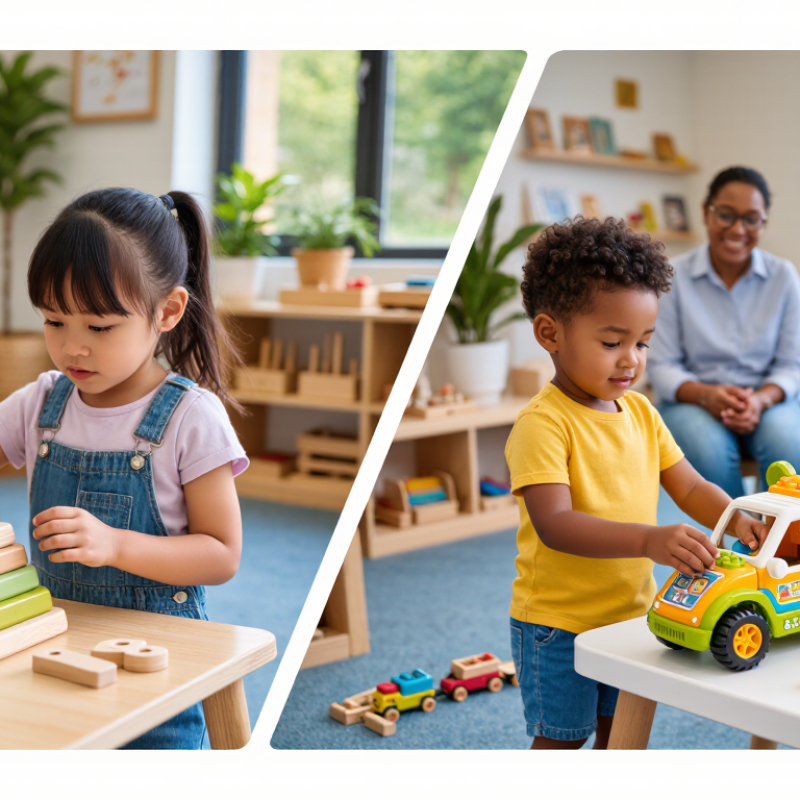
How to Compare Wooden and Plastic Educational Toys in 2026?

Define Wood and Plastic Toy Categories by Age, Function, and Material

How to Compare Wooden and Plastic Educational Toys in 2026?

In 2026, compare educational toys by age, function, and material before judging appearance. For infants, choose large wooden or plastic pieces with smooth edges and easy-grip shapes. Toddlers often need stacking cups, chunky puzzles, and simple sorting toys. Preschool children can use construction sets, counting boards, pretend-play tools, and early science kits. Age labels help, but they cannot replace supervision or a child’s actual development level.

Wooden toys usually feel warm, stable, and durable. Their weight can improve hand control during stacking or balancing activities. Plastic toys are often lighter, washable, and flexible in color or design. They suit water play, sensory activities, and toys with moving parts. However, material quality varies. A wooden toy may splinter if poorly finished. Plastic may crack, fade, or become brittle after heavy use. I have found that “natural” does not always mean safer or more educational.

Tips: Match the material to the task. Use wood for balance, sorting, and quiet construction. Choose plastic for washable play and repeated handling. Check seams, edges, loose parts, and cleaning instructions regularly. Avoid buying by material alone. Watch how the child plays, because the best toy may not match the adult’s first expectation. A simple toy can teach more than a crowded one.

How to Compare Wooden and Plastic Educational Toys in 2026?

Wood and Plastic Toy Categories by Age, Function, and Material

The chart uses a practical 1–5 suitability index based on common material characteristics. Wooden toys generally provide rigidity, tactile variation, and long service life, while plastic toys are often easier to wash, lighter, and more adaptable to complex shapes. For every age group, safety depends on size, construction, finish, and the absence of detachable choking hazards—not on material alone.

Index meaning: 1 = less suitable for the listed combination; 5 = highly suitable. The values are comparative educational guidance, not market-share or sales data.

Compare Safety Using ASTM F963-23, EN 71, and CPSC Injury Data

When comparing wooden and plastic educational toys, assess the finished product, not the material alone. ASTM F963-23 examines accessible edges, small parts, magnets, sound, and battery compartments. EN 71-1 covers mechanical and physical properties, while EN 71-2 addresses flammability. EN 71-3 tests migration of elements from materials and coatings.

Look closely.

A wooden puzzle should have sealed edges, stable joints, and coating documentation. A plastic counting set needs smooth seams and secure parts. Plastic is easier to wipe after snack-time use, but scratches can create hidden dirt points. Wood may feel warmer, yet chipped paint or raised grain deserves immediate attention. Neither material automatically proves safer.

CPSC surveillance gives useful context. Its 2023 Toy-Related Deaths and Injuries report estimated about 231,000 toy-related emergency-department injuries among children under 15 in the United States. The report links many incidents to falls, ride-on products, and small components, rather than one specific material. That distinction matters when choosing classroom toys.

In practical checks, measure detachable pieces against the applicable small-parts test cylinder. Inspect after washing, dropping, and repeated classroom handling. Ask for conformity records, age grading, and laboratory test dates. ASTM F963-23 became a stronger reference for U.S. toy evaluations, but paperwork can still miss real wear. A better comparison combines standards, injury surveillance, and honest hands-on inspection.

Evaluate Durability, Hygiene, Repairability, and Total Ownership Cost

Wooden and plastic educational toys behave differently under daily classroom pressure. Solid wood usually resists deep scratches, while plastic tolerates water, drops, and frequent washing. Neither material wins every test. Check joints, edges, paint condition, and hidden cavities before purchase. The U.S. Consumer Product Safety Commission’s 2023 annual report recorded over 200,000 emergency-department toy-related injuries in the United States. Safer construction matters more than material preference.

Hygiene depends on design. Plastic pieces with smooth, sealed surfaces are easier to wash and disinfect. Wood absorbs moisture, so it needs prompt drying and careful cleaning. Avoid soaking it. The Centers for Disease Control and Prevention recommends cleaning before disinfecting when surfaces carry visible dirt. This distinction is often missed. Test ten cleaning cycles, then inspect swelling, cracks, odor, and loose coatings. A practical test beats a confident brochure.

Repairability changes total ownership cost. Replaceable screws, simple wheels, and separately available parts can extend useful life. Glued wood may be difficult to repair, despite its sturdy appearance. The OECD’s Global Plastics Outlook reports that only 9% of plastic waste was recycled globally in 2019, so disposal should not be treated as a complete solution. The U.S. Environmental Protection Agency reported an 8.7% plastic recycling rate in 2018. Calculate purchase price, cleaning labor, replacement parts, and disposal. My first estimate ignored missing pieces. That was a costly mistake. Track actual repairs for one school term, then revise the comparison.

Assess Environmental Impacts Through ISO 14040 Life-Cycle Methods

Comparing wooden and plastic educational toys in 2026 requires more than checking material labels. An ISO 14040 life-cycle study begins by defining the functional unit. For example, one toy delivering 500 hours of learning can anchor the comparison. This prevents unfair comparisons between different sizes, lifespans, and functions.

The assessment should include raw materials, manufacturing, packaging, transport, use, and disposal. Wood may require drying, machining, and protective coatings. Plastic may require energy-intensive molding but weigh less during transport. Durability also changes the result. A sturdy toy used by several children may reduce impacts per learning hour. A fragile toy may perform worse, despite its renewable material.

Real project data improves reliability. Manufacturers, educators, and researchers should record material mass, factory energy, transport distances, repair rates, and end-of-life routes. ISO 14040 supports this structure, but it does not produce one universal winner. Local electricity, recycling access, and user behavior can alter the outcome. Our first comparison was too neat. We treated disposal as predictable, although many household pathways remain uncertain. That weakness deserves disclosure.

A credible review should test several scenarios, including long use, early breakage, repair, reuse, recycling, and landfill disposal. It should also report assumptions and missing data clearly. Renewable sourcing alone does not prove lower impact. Likewise, lower weight does not guarantee better performance. A transparent life-cycle comparison helps buyers judge environmental trade-offs without hiding uncertainty.

Use Circana’s 2023 8% U.S. Toy-Sales Decline to Frame 2026 Choices

How to Compare Wooden and Plastic Educational Toys in 2026?

Circana reported an 8% decline in U.S. toy sales during 2023. That figure makes every 2026 purchase deserve closer attention. Families and educators may favor toys that offer lasting learning value, not quick entertainment. Wooden toys often provide weight, texture, and quiet sensory feedback. Plastic toys can offer bright colors, movable parts, and easier cleaning. Neither material guarantees better education. The activity design matters more.

Use a simple classroom test. Watch whether children create stories, solve problems, or repeat one action. A wooden shape sorter may support patience and hand control. A plastic counting set may make number patterns easier to see. Check edges, seams, stability, and readable instructions. Also consider storage. A heavy wooden set can occupy a crowded shelf. Lightweight plastic pieces may disappear under furniture. That is a small but real cost.

Tips: Compare cost per year, not only the checkout price. Ask whether replacement pieces are available. Choose materials that suit the child’s age and environment. Wipeable surfaces help in shared classrooms. However, frequent cleaning may fade printed details. That trade-off deserves attention. Review safety guidance from reliable educational or public-safety sources, and inspect toys regularly. A beautiful toy can still become boring. Leave room for that possibility.

How to Compare Wooden and Plastic Educational Toys in 2026? - Use Circana’s 2023 8% U.S. Toy-Sales Decline to Frame 2026 Choices
Comparison Dimension Wooden Educational Toys Plastic Educational Toys 2026 Buying and Product-Planning Implication
Material profile Usually made from solid wood, plywood, or wood-based composites. Properties vary by species, coating, construction, and moisture exposure. Usually made from thermoplastics such as polypropylene, polyethylene, ABS, or PVC. Properties vary by resin, additives, wall thickness, and molding method. Compare the actual material and construction rather than using “wood” or “plastic” as a complete quality indicator.
Weight and handling Common solid woods generally have densities of approximately 0.4–0.9 g/cm³, so many wooden pieces feel substantial and stable. Common toy thermoplastics generally have densities of approximately 0.9–1.4 g/cm³, while hollow molding can make finished toys much lighter. Choose heavier, stable pieces for stacking and fine-motor work; choose lighter pieces when portability and independent handling are priorities.
Durability in normal use Can resist repeated handling and may be sanded or repaired when solid and well finished. Can tolerate drops, repeated washing, and high-volume use when the selected resin and design are appropriate. For classrooms and lending libraries, evaluate drop resistance, joints, edges, coatings, and replacement-part availability—not only the base material.
Water and moisture resistance Unfinished wood can absorb moisture, swell, stain, or develop surface damage; sealed wood performs better but still should not be soaked for long periods. Most commonly used toy plastics are non-absorbent and tolerate routine surface cleaning well. Use plastic for water-play or frequent wash-down settings; use sealed wood where its tactile qualities are important and moisture can be controlled.
Cleaning and hygiene Requires cleaning methods compatible with the finish. Prolonged soaking and high heat can damage some wooden products. Usually supports easier wipe-clean maintenance because smooth plastic surfaces do not absorb water. For shared educational environments, specify a documented cleaning method and check seams, cavities, and textured surfaces for soil retention.
Repairability Solid wooden parts can often be sanded, refinished, or joined again if damage is limited. Some molded plastic parts can be replaced, but cracked housings and welded or sealed components are often difficult to repair. Prioritize replaceable components and simple construction when total ownership cost matters more than the initial purchase price.
End-of-life considerations Untreated wood can biodegrade under suitable conditions; painted, glued, laminated, or composite wood may require disposal as a mixed material. Plastic is generally not biodegradable. Recycling depends on the resin identification, local collection rules, product size, and material separation. Record material composition, avoid unnecessary mixed-material construction, and check local recycling or reuse pathways before making environmental claims.
Sensory and learning experience Often provides a natural texture, visible grain, and a lower-gloss surface that can support tactile exploration and open-ended play. Supports bright colors, transparent parts, flexible forms, precise shapes, and integrated moving or electronic components. Match the material to the learning objective: tactile sorting and construction may favor wood, while color coding, modularity, and functional mechanisms may favor plastic.
Safety checkpoints Check for splinters, sharp corners, loose components, peeling finishes, and small parts that may create a choking hazard. Check for sharp flash, cracked parts, detachable small components, battery access, and damage that creates exposed edges. Apply the relevant toy-safety and age-grading requirements in the target market; material choice does not replace safety testing or inspection.
Market context for 2026 U.S. toy sales declined by 8% in 2023, creating a more value-conscious environment for future purchasing decisions. In 2026, compare educational value, expected service life, cleaning burden, repairability, and total cost—not just the shelf price or material story.
Decision rule for 2026: Choose wooden toys when tactile interaction, repairability, and open-ended construction are central. Choose plastic toys when washability, moisture resistance, lightweight portability, precise molding, or integrated mechanisms are more important.
Data basis: The 8% U.S. toy-sales decline refers to 2023 market reporting cited in the title. Material density ranges are typical engineering ranges and vary by species, resin, additives, and product design. Safety and recycling outcomes depend on the finished product and local requirements.

FAQS

Which is safer for educational toys, wood or plastic?

Neither material is automatically safer. A wooden toy needs sealed edges, stable joints, and intact coatings. Plastic toys need smooth seams and secure parts. Safety depends on the finished design.

What safety features should buyers inspect?

Check accessible edges, detachable pieces, magnets, sounds, and battery compartments. Measure loose pieces with the applicable small-parts test cylinder. Inspect every cavity. Tiny gaps can hide problems.

What do injury statistics reveal about toy safety?

A 2023 U.S. surveillance report estimated about 231,000 toy-related emergency injuries among children under fifteen. Many incidents involved falls, ride-on products, or small components. The data does not prove one material is more dangerous.

How should classrooms clean wooden and plastic toys?

Smooth, sealed plastic usually tolerates frequent washing better. Wood should be cleaned carefully and dried promptly. Avoid soaking wooden pieces. Clean visible dirt before disinfecting. Test ten cleaning cycles.

What damage should appear after repeated classroom use?

Look for swelling, cracks, odor, loose coatings, raised grain, and sharp edges. Check joints after dropping and washing. Scratches on plastic may create hidden dirt points. Some damage is easy to miss.

How can buyers compare repairability and ownership costs?

Look for replaceable screws, simple wheels, and separately available parts. Glued wooden pieces may look sturdy but resist repair. Include cleaning labor, replacements, repairs, and disposal costs. My first estimate missed lost pieces.

How can environmental impacts be compared fairly?

Define one useful function, such as 500 hours of learning. Include materials, manufacturing, packaging, transport, use, repair, and disposal. A lightweight toy may transport efficiently but fail early. Renewable material alone proves little.

What information should a credible environmental comparison disclose?

Report material weight, factory energy, transport distance, repair rates, and disposal routes. Compare long use, early breakage, reuse, recycling, and landfill scenarios. Local conditions matter. The result may remain uncertain.

Conclusion

Choosing between wooden and plastic educational toys in 2026 requires more than judging appearance or price. The best comparison starts by grouping toys according to a child’s age, learning purpose, and material characteristics. Safety should be reviewed against ASTM F963-23 and EN 71 requirements, while public injury data from the CPSC can provide broader context. Parents and educators should also consider durability, cleanliness, repairability, and total ownership cost, including replacement and maintenance.

The question “are wooden educational toys better than plastic ones” has no universal answer. Wood may offer strength, tactile appeal, and easier repair, while plastic can provide lighter weight, washable surfaces, flexible designs, and lower initial costs. Environmental performance should be assessed through ISO 14040 life-cycle methods, considering production, transport, use, and disposal rather than material alone. With U.S. toy sales declining by 8% in 2023, thoughtful 2026 choices should prioritize safety, educational value, long-term usefulness, and responsible resource use over trends.

Sienna

Sienna

Sienna is a skilled marketing professional with a deep expertise in our company’s core products and services. With a passion for innovation and detail, she plays a pivotal role in crafting insightful blog posts that not only highlight the unique features of our offerings but also provide valuable......