China Best Educational Toys Help Child Development?

Time:2026-10-27 Author:Mason
0%

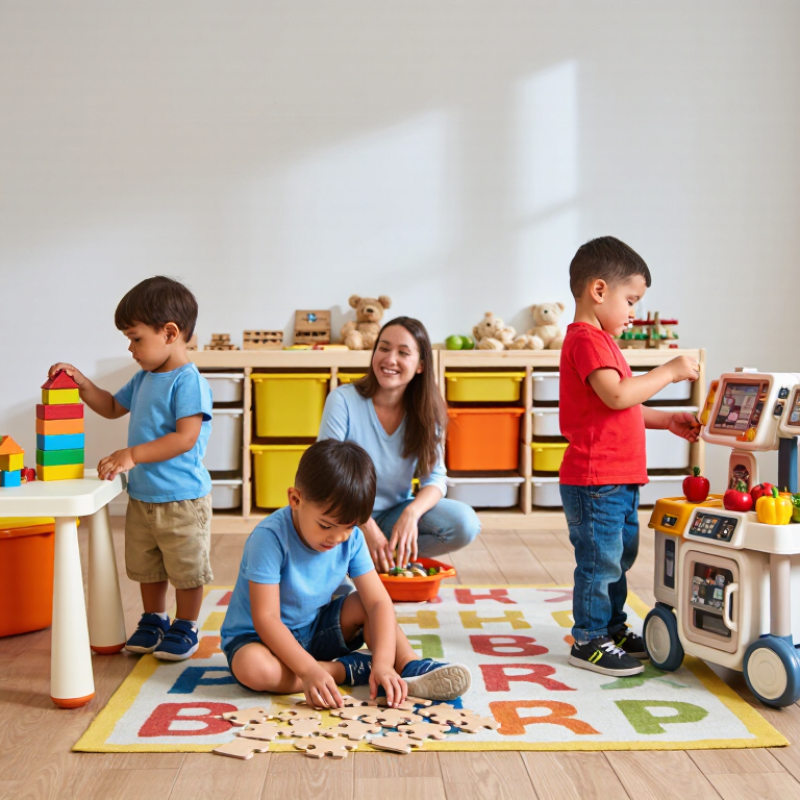
China’s educational toy market is growing, but “best” should mean more than bright packaging or a high price. The strongest products invite children to touch, build, sort, imagine, and solve small problems. A wooden puzzle may strengthen spatial reasoning, while a pretend grocery set can encourage language, cooperation, and emotional expression. These moments are simple. They are also measurable learning experiences.

So, how do educational toys help child development? UNICEF and The LEGO Foundation’s Learning through Play report identifies five important characteristics: joyful, active, engaging, meaningful, and socially interactive play. These principles align with guidance from the American Academy of Pediatrics, which links play with executive function, communication, and social development. Industry evidence adds commercial context. Circana’s global toy market reports consistently show strong demand for games, construction sets, and activity-based products, suggesting that families increasingly value toys with developmental purposes. However, sales growth does not prove developmental impact.

Quality still requires careful judgment. China’s leading toy manufacturers can offer thoughtful designs, child-sized materials, clear instructions, and testing against relevant safety standards. Parents should check age suitability, small parts, battery access, and material information. A toy with many buttons may look educational but produce little thinking. Sometimes, an empty cardboard box creates richer play. That detail is easy to overlook. This article examines how Chinese educational toys may support cognitive, physical, language, and social growth, while recognizing an important limitation: toys support development best when caring adults talk, observe, and play alongside children.
China Best Educational Toys Help Child Development?

Definition and Role of Educational Toys in Child Development

China Best Educational Toys Help Child Development?

Educational toys are play materials intentionally designed to encourage learning through active exploration. Their value is not determined by bright colors or electronic features. A well-designed puzzle can develop spatial reasoning, while stacking blocks can support coordination, planning, and early mathematics. The American Academy of Pediatrics stated in its 2018 clinical report that play strengthens language, executive function, social skills, and emotional development. These benefits appear during real interaction, such as a child sorting wooden shapes, explaining choices, and changing strategies after failure.

Play also supports healthy physical development. The World Health Organization’s 2019 guidelines recommend at least 180 minutes of physical activity daily for children aged three to four. At least 60 minutes should involve moderate-to-vigorous movement. Educational toys should therefore include active options, not only seated tasks. A balance board, construction set, or movement game can make learning more physical and memorable. UNICEF’s 2018 Learning through Play report emphasizes that play is engaging, meaningful, interactive, and socially supported. Adult participation matters.

The label can mislead.

A costly toy may offer limited learning if it gives only one correct response. In practical use, open-ended materials often create richer conversations and longer concentration. Safety, age suitability, durability, and accessible instructions remain essential when evaluating toys made in China or elsewhere. Evidence is still imperfect. Toy choice alone cannot repair limited interaction, stress, or inadequate playtime. The strongest developmental effect usually comes from the toy, the child, and a responsive adult working together.

Key Features of High-Quality Educational Toys from China

China Best Educational Toys Help Child Development?

High-quality educational toys from China should do more than add bright colors to a shelf. They need a clear learning purpose, suitable difficulty, and durable construction. UNICEF and the LEGO Foundation’s Learning through Play report identifies five valuable qualities: joyful, active, engaging, meaningful, and socially interactive play. Strong products reflect these qualities through stacking blocks, problem-solving games, sensory boards, and open-ended building parts.

Safety remains a practical test. Check rounded edges, secure battery compartments, non-toxic materials, and readable age guidance. Reliable manufacturers should provide test records linked to relevant standards, such as EN 71, ASTM F963, or China’s GB 6675. The OECD’s Starting Strong reports also support play-based learning for early development, especially language, self-regulation, and social skills. However, a toy claiming to build “advanced intelligence” deserves skepticism. Packaging often promises too much.

Tips: Choose toys that allow several solutions, not one correct answer. Watch a child use the toy for ten minutes. If interest disappears quickly, the design may be attractive but shallow. Prefer washable surfaces, strong hinges, and pieces large enough for the recommended age. Ask suppliers about material traceability, factory inspections, and sample testing before placing a large order. Digital features can add value, but simple wooden parts often encourage richer conversation and imagination.

How Educational Toys Support Cognitive and Language Growth

Educational toys can turn ordinary play into a small language laboratory.

A picture puzzle invites a child to name colors, shapes, and familiar objects. When pieces do not fit, the child practices attention, memory, and flexible problem-solving. The learning feels natural because hands stay busy.

“Where does this go?” encourages prediction.
“Tell me about it” invites longer answers.

These moments connect words with actions, not isolated drills.

Cognitive growth also depends on repeated, manageable challenges. Sorting buttons by size, building a tower, or matching sounds strengthens comparison and working memory. Adults can model precise language:

“The red block is under the bridge.”

Children then hear useful grammar in context. Open-ended toys may support more conversation than toys that speak constantly. A flashing sound can attract attention, but it may leave little room for the child’s voice.

Quiet play is not empty.

Good practice includes watching the child, not just following instructions. If a puzzle causes frustration, offer one hint, then pause. If the child changes the rules, ask why before correcting them.

I would not treat every mistake as a problem; unusual answers can reveal creative thinking.

Yet toys alone cannot teach language reliably. Warm conversation, shared reading, and patient listening remain essential. Progress may appear as one new word, a clearer request, or a story about a three-block tower.

Small evidence deserves careful attention, and some play sessions will simply be messy.

Benefits for Social, Emotional, Physical, and Creative Development

China’s educational toys can support child development when play matches the child’s age and interests. UNICEF’s Learning through Play report explains that guided play strengthens cognitive, social, emotional, physical, and creative skills. Open-ended blocks, role-play sets, and cooperative puzzles encourage children to share, negotiate, and express feelings. The best toys are not always the most complex. A simple wooden shape sorter may create more conversation than a noisy electronic toy.

Physical development also needs attention. WHO guidelines recommend at least 180 minutes of daily physical activity for children aged three to four, including 60 minutes of moderate-to-vigorous movement. Toys that involve throwing, balancing, building, or carrying can support coordination and muscle control. Creative play adds another layer. Drawing tools, clay, and loose construction pieces let children test ideas without one correct answer. Still, toy quality alone cannot guarantee progress. Adult interaction, safe space, and repeated practice matter more than packaging.

Tips: Choose toys with multiple uses. Watch how the child plays, then ask open questions. Rotate toys every few weeks to renew interest. Avoid replacing conversation with screens. Research from the OECD links early learning quality with responsive adult support, yet many homes may lack time or space. That limitation deserves honest consideration. A small basket of carefully chosen toys can still create meaningful play. Reference: UNICEF, Learning through Play, 2018; WHO, Guidelines on Physical Activity, Sedentary Behaviour and Sleep, 2019; OECD, Engaging Young Children, 2018.

How Educational Toys Support Child Development

Educational toys can support multiple areas of early development. The scores shown are evidence-informed opportunity ratings on a 0–5 scale, reflecting how strongly open-ended, age-appropriate play can encourage social, emotional, physical, and creative skills. Actual benefits depend on the child’s age, interests, adult interaction, and play environment.

How to Choose Safe and Age-Appropriate Educational Toys

China Best Educational Toys Help Child Development?

Safe, age-appropriate selection matters more than a toy’s country of origin. Check the recommended age, warning labels, and intended skill. A puzzle for older children may frustrate a toddler. Small parts matter. For children under three, avoid detachable pieces that can fit through a small-parts tester. Inspect seams, wheels, magnets, and battery compartments. Avoid sharp edges, loose cords, peeling paint, and easily opened covers.

Choose toys that match real development, not adult expectations. Large blocks can build grip strength, balance, and early planning. Simple counting pieces support language when an adult names colors and compares quantities. Pretend-play sets may encourage storytelling, but only when children can use them safely. I have seen children ignore impressive toys and repeatedly choose cardboard boxes. That is useful feedback, not failure. A toy should invite action, not perform everything for the child.

For products made in China, request clear material information and traceable safety documentation from the seller. Look for testing against recognized toy-safety requirements in your market. Documentation matters, but it does not replace daily inspection. Inspect often. Washable surfaces help, especially for toys handled during meals. Follow battery instructions carefully, and keep button batteries inaccessible. Supervise water play, movement toys, and toys with long parts. Age labels can be imperfect. Children develop unevenly, so observe your child’s abilities and remove a toy when it becomes damaged or unsafe.

FAQS

What are educational toys?

Educational toys encourage learning through active exploration, not passive watching.

How do educational toys support social and emotional development?

Cooperative puzzles encourage sharing, negotiation, and patience.

Should educational toys include physical activity?

Yes. Children also learn through movement.

Are expensive or electronic toys better for development?

Not necessarily. A costly toy may allow only one response.

How can adults improve play with educational toys?

Watch the child before giving instructions.

How should parents choose age-appropriate toys?

Check the recommended age, warnings, and intended skill.

What safety details should adults inspect?

Check seams, wheels, magnets, battery covers, cords, and painted surfaces.

How can families use toys when space or time is limited?

Keep a small basket of versatile toys.

Conclusion

Educational toys play an important role in children’s overall development by combining learning with enjoyable, hands-on experiences. Rather than simply providing entertainment, they encourage children to explore, solve problems, ask questions, and understand the world around them. High-quality educational toys from China often feature durable materials, thoughtful designs, clear functions, and activities suited to different stages of growth. These toys can support early cognitive and language development through puzzles, building tasks, storytelling, matching games, and interactive learning activities.

The benefits extend beyond academic skills. Educational toys help children practice sharing, cooperation, communication, patience, and emotional expression while also strengthening fine motor skills, coordination, imagination, and creativity. Parents and educators should consider a toy’s safety, material quality, age suitability, complexity, and educational purpose before making a choice. Understanding how do educational toys help child development makes it easier to select toys that are safe, meaningful, and appropriately challenging, allowing children to learn confidently through play.

Mason

Mason

Mason is a seasoned marketing professional with a deep expertise in the company's offerings and a passion for driving brand awareness. With a strong background in digital marketing strategies, he has an innate ability to connect with diverse audiences and effectively communicate product benefits.......